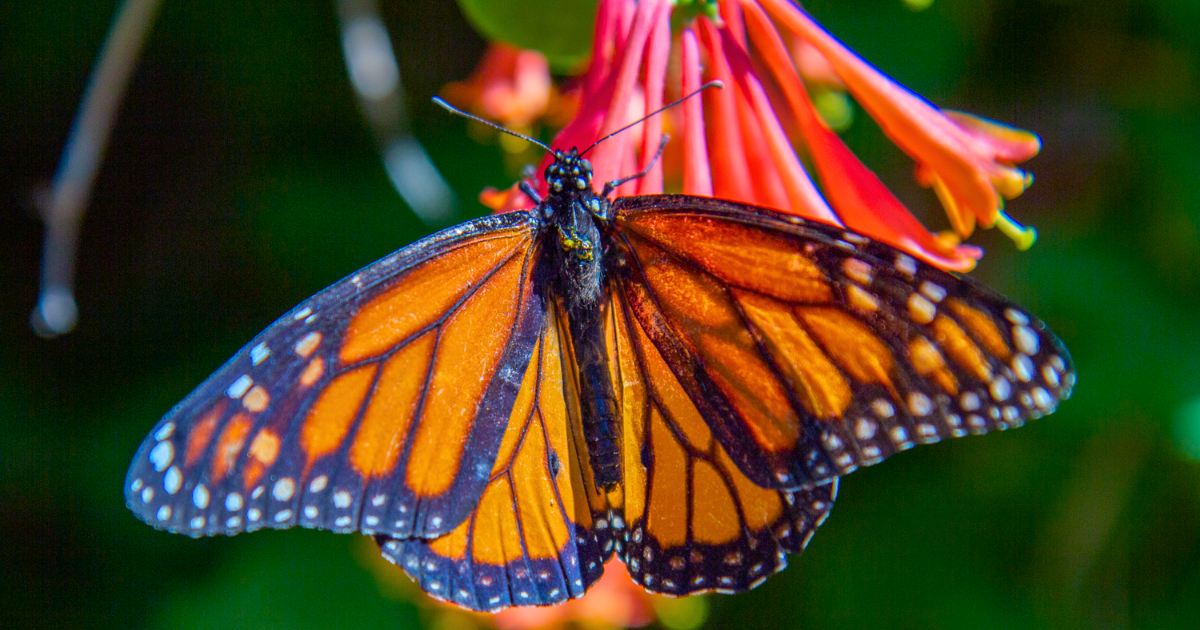
The Monarchs
Every autumn, something almost unbelievable happens across North America. Hundreds of millions of monarch butterflies — insects weighing less than a paperclip — lift off from fields and roadsides and begin a journey of up to three thousand miles to a mountain forest in central Mexico they have never seen before.
They have never made the trip. Their parents didn’t either. Or their grandparents. The monarchs that arrive each November in the oyamel fir forests of Michoacán are, on average, four generations removed from the last butterfly that made the same journey. No one taught them the route. No elder led the way. They simply know — carried by something written into them before they ever emerged from their chrysalis.
I find it hard to think about that for very long without feeling something loosen in my chest.
A Creature Designed for Transformation
Before the migration, there is the metamorphosis. Most of us learned about it in school, but familiarity has a way of dulling wonder. Consider what actually happens inside that chrysalis.
The caterpillar doesn’t just grow wings. It dissolves. Almost entirely. The larval body breaks down into a kind of biological soup — most of its structures dismantled at the cellular level — and from that undifferentiated material, an entirely new body assembles itself. Different legs. Different eyes. Wings where no wings existed. A body built for the sky rather than the leaf.
Biologists call the intermediate stage histolysis: the deliberate destruction of what was, to make room for what will be. The caterpillar doesn’t resist the process. It surrenders to it.
There’s a word for that in older theological language: kenosis. Emptying. The willingness to let the old form go so that something new can take shape.
The Navigation Problem
Scientists have spent decades trying to understand how monarchs find their way. The answer turns out to be layered and almost impossibly elegant.
Monarchs use the sun as a compass — but since the sun moves across the sky, a fixed sun-compass would lead them in circles. So they have an internal circadian clock, housed in their antennae, that compensates for the sun’s movement throughout the day. They always know, within their small bodies, what time it is — and they correct their heading accordingly.
When skies are overcast, they switch to a secondary system, sensing the polarization patterns of light filtering through clouds. When neither system is sufficient, some researchers believe they may also detect the Earth’s magnetic field.
They are carrying, in a body the size of your thumbnail, three independent navigational systems — any one of which alone would be remarkable. Together, they form a guidance apparatus more reliable than most technology we’ve built.
And all of it is pointing them toward a place they’ve never been, to a forest where their great-great-grandparents overwintered, a forest the species has returned to for thousands of years.
What the Mountain Looks Like
If you’ve seen photographs of the monarch overwintering sites in Mexico, you know they are unlike anything else on Earth. The oyamel firs turn orange with the weight of butterflies — an estimated ten million per acre at peak density. The branches bow. The air moves with wings. When the temperature rises mid-morning and the monarchs begin to stir, the sound has been described as rain.
People who have stood inside that forest often describe it as a religious experience — and not in the vague way people sometimes use that phrase. They mean something more specific: the feeling of being small inside something vast and purposeful. The feeling that you are witnessing something arranged, not accidental.
The indigenous Mazahua and Purépecha people of the region have long believed the monarchs carry the souls of the departed, returning each year around the time of Día de los Muertos. Whether or not you share that belief, there is something in it worth sitting with: the intuition that these small returning creatures are messengers, that their faithfulness to the journey means something.
On Smallness and Faithfulness
The monarch doesn’t know it’s making history. It doesn’t know that humans will drive hours to watch it pass, or that scientists will spend careers studying the geometry of its wings. It doesn’t know that its population has declined by more than eighty percent in the last two decades, or that people in dozens of countries are planting milkweed in its honor.
It only knows the pull. South and west. Toward warmth. Toward a mountain it cannot remember but somehow recognizes.
There is something quietly instructive in that. We are often looking for grand confirmation before we move — clear signs, audible voices, certainty about the destination before we take the first step. The monarch has none of that. It has a direction and a body made for the journey, and it goes.
Jesus said the Father knows when a sparrow falls. If that’s true, I think it’s also true that He knows when a monarch lifts off from a milkweed patch in Ontario and begins three thousand miles of faithful, improbable flight.
Watching the Sky
If you want to see them, the peak migration through the central United States runs from late September into October. They tend to travel in loose groups on warm days with a southwest tailwind, drifting low over prairies and roadsides, resting on goldenrod and asters. If you sit still long enough in the right place, they will land near you. Sometimes on you.
For a moment, you are part of the route. A brief waypoint on a journey older than any road, guided by something you can’t fully explain, heading somewhere you’ll never see.
That seems like enough to keep a person humble for a while.